Title IX Challenges
Title IX Challenges
As an aging Baby Boomer who has watched Women’s Rights go from minimal to almost equivalent to those of men, it has been painful to watch the progression of public involvement go from active advocacy to complacency, followed by backlash and denial of rights. An example of this partial success followed by controversy and reversal of progress is the history of Title IX. Because of these concerns I was eager to be a part of a recent webinar sponsored by the Washington Online Branch of the American Association of University Women (AAUW). We were fortunate to have the support of three outstanding panelists who were familiar with both the history and the current status of the legislation and its regulations:
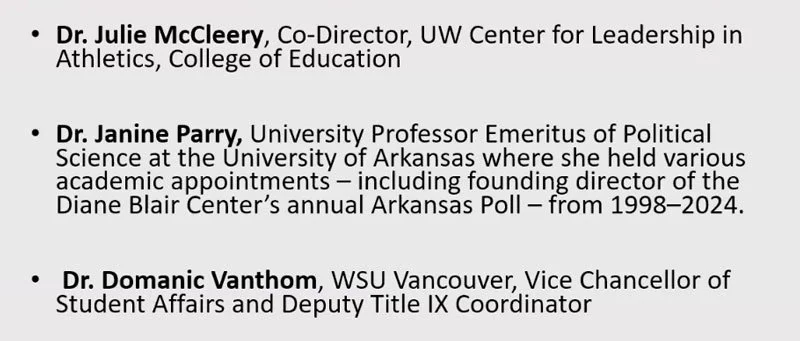
Bios for Dr. Julie McCleery,, Dr. Janine Parry, and Dr. Dominic Vanthom
The 90-minute webinar and the PowerPoint slides provide an excellent summary of the progress and current challenges of the legislation that was intended to ensure that discrimination based on gender did not occur in our educational institutions. In my own experience during the 60s, girls had little or no opportunity to be part of inter-scholastic sports. Instead, we had “Play Days” with other schools which seemed, even then, to be rather pointless. We had intramural sports after school with half-court rules for basketball, so we didn’t get too tired. As the statistics show in the webinar, very few girls participated in sports compared to boys. In my college and graduate school experience, I had one female professor in college (other than physical education instructors) and only one female professor in three years of law school. My college had a rule which artificially limited the number of female students allowed to enroll and my law school class was only about 10% female.
As explained in the webinar, the rights of women and their presence in sports and at colleges and universities has expanded to the point that some people argue that boys and men are now the disadvantaged ones, even though we know there is still a large wage gap affecting women, a noticeable absence of women in certain professions, and a significant lack of women in leadership and upper-level political positions. There are also serious issues regarding sexual harassment, the need for childcare, and gender identity.
The webinar ends with a discussion of what you can do to advocate for equity. The slides provide contact information for many organizations you might want to join with. Please follow this link to the Washington Online Branch website, copy and save the webinar password, then click on the webinar link to watch the program. It starts slowly because the host was waiting for participants to log in – more than 100 watched live. Afterwards you can follow the link to the PowerPoint slides and consider saving them on your device for future reference.
Please do you part to help preserve equity and fairness for all people!