
Communicating Across Differences
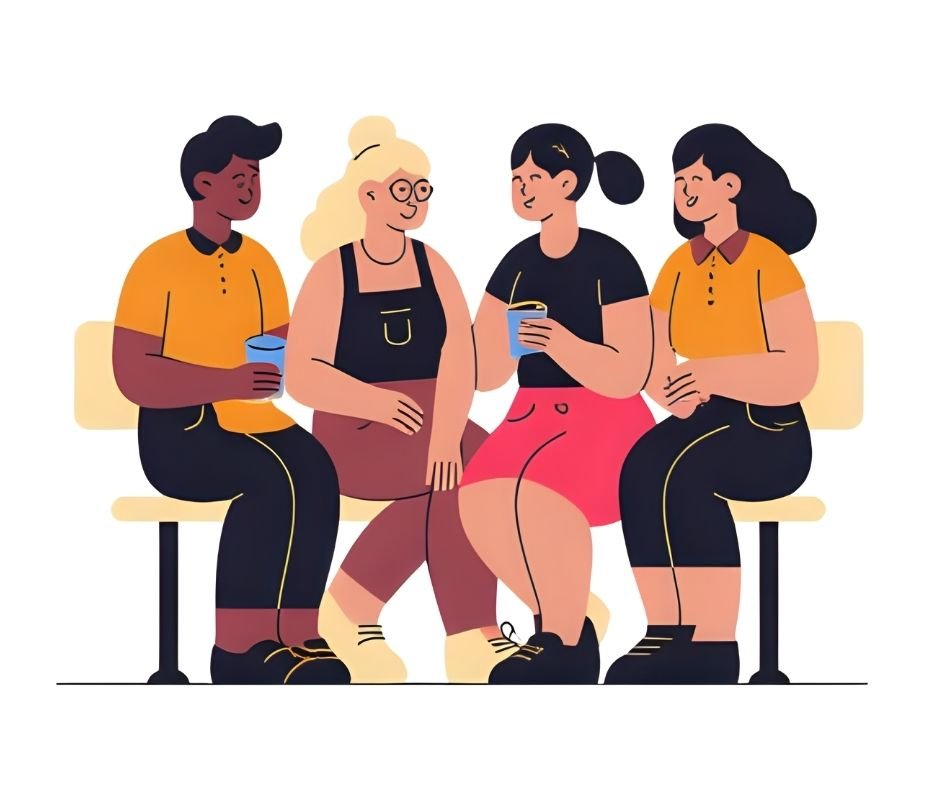
AI-created image of 4 people talking
Communicating Across Differences
Have you ever been corrected or challenged because of a word you used that someone else found either inappropriate or offensive? This probably happens to all of us from time to time. One human response is to become defensive, justifying why that word was ok and implying that the other person is overly sensitive or is misinterpreting the word. Another reaction is to think or say that the other person is being the “word police,” trying to “cancel culture” or trying to enforce “political correctness.” We might be better off to listen carefully to the criticism and try to learn from it.
Here are some examples from my own experience. Many years ago I gave a talk at a conference and I referred to a work colleague as being “Oriental.” Perhaps I was trying to describe the diversity of the employees at my workplace. After the presentation, someone who was not Asian suggested to me that using the term “Oriental” could be offensive to some people. I had not heard that before and was grateful to learn that there was a problem with how I had characterized my colleague. The preferred terminology would depend on the circumstances, but a better way to describe the situation might have been to say that two co-workers were of Asian heritage. In this case I was quite embarrassed and flustered to be on the receiving end of this comment, but I was also grateful to learn of my mistake and grateful that it was a non-Asian person pointing out the problem. I think it would have been even more awkward to know that I had offended a person in the audience who was of Asian background.
A recent example of a communication snafu occurred when two good friends and I were discussing racial diversity. One person commented that she had no trouble interacting with people of different races because “she didn’t see color.” The other friend in the group commented that, in today’s world, we are encouraged to see color, in the sense of seeing and appreciating differences. The first friend was confused by this and looked at me to see if I agreed. I had heard this discussion before and readily agreed that the generally accepted way of dealing with differences was to recognize that they exist but to use that recognition as a way to be helpful or understanding, not to engage in unfair treatment or to subject the person to insensitive jokes or stereotypes.
A very recent communication issue occurred when I put up a blog post regarding Title IX. To some men, just the term “Title IX” triggers a negative reaction. I tried to communicate with the individuals who were criticizing my post. In the process, I learned that certain people, mostly politically right-leaning men, are triggered by use of the words “equity,” “fairness,” and “empathy.” As we’ve seen in the news, these same people appear to be opposed to “diversity” and “inclusion” as well. For those of us who would like to look for common ground with people having a different political orientation, it may be necessary to avoid the words that trigger arguments and accusations. Maybe we need to just talk about our pets, favorite foods, and sports. I haven’t resolved this particular communication problem, but I will try to be more careful about use of the “trigger” words. When these critics began posting outright lies and insulting generalizations, I cut off the comments and then received a private message chastising me for cutting off communication.
In the midst of this debate about Title IX, I got a helpful comment. A reader referred me to an article containing instruction about how to write effectively when the audience contains persons of different backgrounds. Here’s the link and I highly recommend you read the article:
https://www.websiteplanet.com/blog/sensitive-writing-guide
According to the note at the bottom of the Website Planet page, we are free to share this information:
Content attribution: Website Planet is the sole owner of the visual and written content on this website. You are free to share our content and visuals on your site, but we ask that you provide a link back to the resource if you do, enabling us to continue providing authoritative reviews and guides to help individuals and businesses thrive online.
Related to his topic, there is another issue, which might be considered “bystander intervention.” That term is sometimes used when a 3rd party intervenes in a physical fight or argument, but I think it can also apply to someone “correcting” another even though the person voicing the “correction” is not a member of the disadvantaged group. The person pointing out a problem might be considered an “ally” of members of the disadvantaged group. The first example I gave in this post about the word “Oriental” could be considered a bystander intervention, although the “victim” was not present.
I once worked in a location where I was the only female professional. It sometimes seemed that certain employees would bait me to see how obnoxious they could be before I would respond. I had to ask myself whether I would ignore the obnoxious comment or take the bait and respond. I had to consider whether the situation justified the energy it took to respond or whether the comment was better ignored. It would have been wonderful if a male employee recognized the unfairness of the behavior and said something to make clear the obnoxious comment or behavior was unacceptable. I don’t recall that ever happening.
On the other hand, someone who thinks they are an expert in inter-racial affairs, may constantly be correcting others without being enough of an expert to know what they are talking about. An example that comes to mind is the use of the terms “Black,” “African American,” and “people of color.” In my experience, individual Black people vary in their preferred terms for themselves and their family members. We can ask them how they prefer to be described, but, in their absence, any of these terms could be appropriate. A white person correcting another white person because one of these terms is used and not another, is not warranted and can be annoying.
Most people want to get along with others and want to find ways of sharing ideas and goals that are not offensive and that can lead to common understanding and friendship. We each need to do our part to improve communication between individuals and among groups. You can start this process by reading or re-reading:
How to Make Your Writing More Sensitive – and Why It Matters
Written by: Melissa Haun
If you enjoyed reading my blog post and following my links, take a look at the list of my other posts, and consider subscribing to my blog. There is no cost and no advertising and posts usually come out about once a month.
Common Sense Reflections posts on related topics. Click here to see a list of posts related to diversity.
Supplemental Note Provided by AI. Partly for my own amusement, I wanted to see what AI had to say about this topic. I think some valid points are made so I’m sharing the following essay which I did not write or edit: Carolyn Hayek
Illustrating Communicating Across Differences
Understanding and Bridging Diverse Perspectives
Introduction
In today's interconnected and multicultural world, communicating effectively across differences is a critical skill. Differences may arise from cultural backgrounds, beliefs, values, languages, or experiences. Successful communication across these divides is essential for building understanding, trust, and collaboration.
What Does It Mean to Communicate Across Differences?
Communicating across differences involves actively listening, seeking mutual understanding, and respecting perspectives that may differ from our own. It means being aware of and sensitive to the unique backgrounds, needs, and viewpoints of others. This process often requires patience, empathy, and adaptability.
Illustrative Example
Imagine a team made up of individuals from different countries, each with their own cultural norms. During a group project, some team members prefer direct feedback, while others view directness as impolite. To communicate effectively:
· Active Listening: Team members focus on genuinely understanding each other's opinions and concerns before responding.
· Clarifying Expectations: The group discusses preferred communication styles and agrees on a respectful approach.
· Empathy: Team members acknowledge that their colleagues’ reactions are shaped by different cultural experiences.
· Adaptability: Individuals adjust their language and tone to ensure everyone feels valued and understood.
Strategies for Effective Communication Across Differences
1. Recognize and Value Differences: Accept that differences exist and can enrich interactions.
2. Ask Open-Ended Questions: Invite others to share their perspectives and experiences.
3. Listen Without Judging: Focus on understanding, not on evaluating or rebutting.
4. Clarify and Paraphrase: Restate what you’ve heard to confirm understanding.
5. Find Common Ground: Identify shared goals or values that unite the group.
6. Be Mindful of Nonverbal Cues: Recognize that gestures and expressions may have different meanings in different cultures.
7. Use Inclusive Language: Avoid jargon or idioms that may not be universally understood.
Conclusion
Communicating across differences is not just about exchanging information—it is about building bridges and fostering respect. By approaching conversations with openness, empathy, and adaptability, individuals and organizations can turn diversity into a powerful asset for collaboration and innovation.