
Greenwood, Mississippi, Surprises
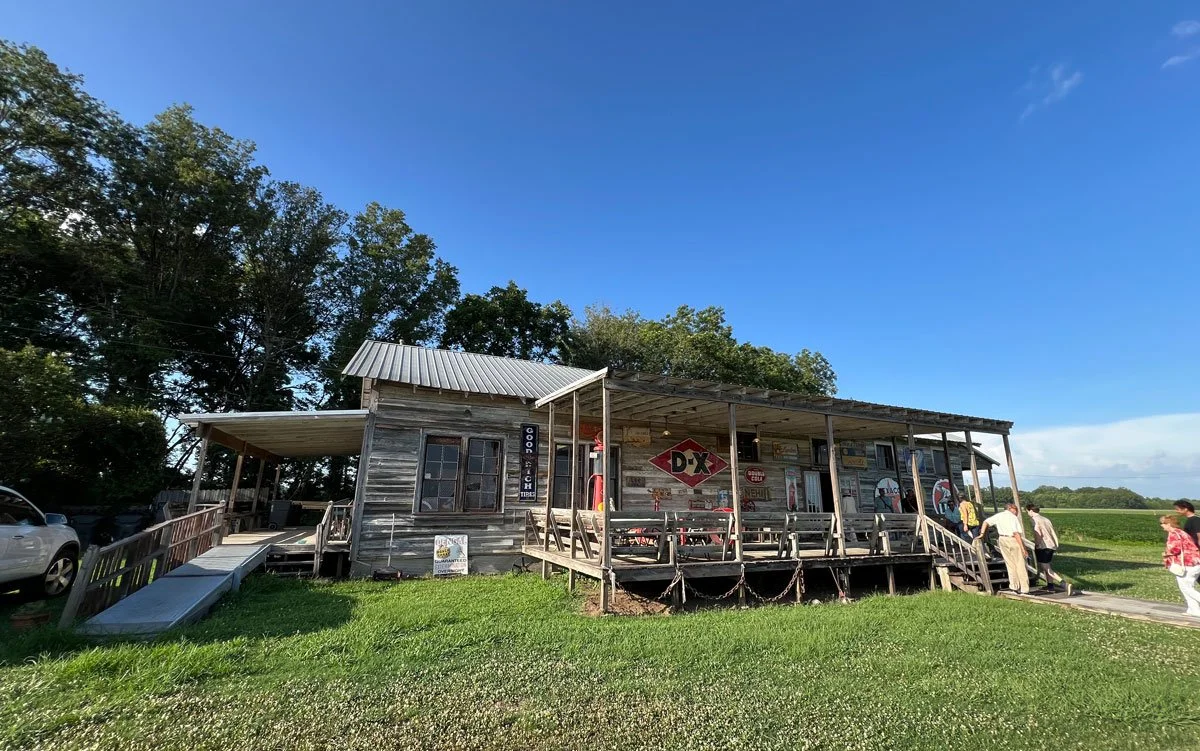
“The Tavern” at Tallahatchie Flats, outside Greenwood, MS
Greenwood, Mississippi, Surprises – Beautiful Homes, Elegant Hotel, Troubling History
My traveling companions and I arrived in Greenwood, MS, on Monday, June 30, 2025. Greenwood’s Alluvian Hotel would be our 5th hotel destination on our 10-day Civil Rights Tour. We arrived hot and tired following a visit to Medgar Evers Home Museum, a national monument, located in Jackson, MS, as well as The Canton Freedom House Civil Rights Museum , where we met and spoke with Canton’s newly elected Mayor, Tim Scott Taylor. It had been a challenging day processing the life and assassination of NAACP field secretary Medgar Evers, as well as the local civil rights history documented in the Canton Museum.
Greenwood (pop. 14,490), in civil rights circles, had become known as the community where 14-year-old Chicago-resident Emmett Till was kidnapped, tortured, murdered, and thrown into the Tallahatchie River in 1955, based on a false accusation that he had grabbed a shopkeeper’s wife, who was working in their small store. The shop owner and his brother were tried on murder charges and found not guilty by an all-White, all-male jury. Later they admitted to the murder and sold their story to Look Magazine for $4,000. This shocking event is sometimes considered the start of renewed civil rights activism, which culminated in Civil Rights Acts adopted in 1957, 1960, 1964, 1965, and 1968, as well as the 24th Amendment to the Constitution (1962) which banned poll taxes. Changes in the law have not been sufficient to assure fairness in Mississippi government. A statue of Emmett Till was unveiled in Greenwood’s Rail Spike Park in 2022, 67 years after his death.
After driving past many modest homes that day, some in great need of repair, it was a surprise to cross the train tracks on the South side of Greenwood and within a few blocks arrive at the elegant Alluvian Hotel . The luxury of the hotel was in great contrast to other facilities we had been to, making me curious how it came to be in Greenwood. A little research helped me discover its history.
The Alluvian Hotel, opened in 2003, is owned and operated by the Viking Range Corporation , headquartered in Greenwood. In 2005, Viking also opened a 7,000-square-foot spa , a cooking school, and a restaurant. The Viking Range Corporation began operation in 1987 and now employs 1,000 people in four manufacturing facilities around the county where Greenwood is located. In 2013, the Middleby Corporation acquired Viking Range Corporation for $380 million in cash.
Our dinner on June 30th was scheduled to occur in the “Tavern” at The Tallahatchie Flats , 3 miles north of Greenwood. To get there our tour bus drove north from the hotel along Greenwood’s Grand Boulevard, the location of 21 impressive mansions, featured in a tourist brochure published by visitgreenwood.com, which describes the boulevard as “One of America’s ten most beautiful streets.” We were told that these homes seldom are available for purchase since they customarily are passed through the generations to family members.
During our drive through the city we also learned that the Greenwood has been the location for several movies, including “The Help,” a 2011 movie I had seen and enjoyed. Many local residents were involved in the production.
The appearance of our dinner location was a surprise. We were definitely out in the country, with green fields all around. The buildings at Tallahatchie Flats are described on their own website as “shacks” or “flats”. They are apparently available for daily, weekly or monthly rentals. The building the website refers to as the “Tavern” looks similar to the “shacks” but a little larger. We had a charming host at dinner, Sylvester Hoover. He would also be our guide the next day. He explained that the property where we were having dinner had been a cotton plantation for generations. His own ancestors had been enslaved there. Over time family members became sharecroppers and then employees, continuing with basically the same work. He said it was also where he grew up. He now lives elsewhere and is employed in a variety of ways: he runs a small convenience store, is trying to establish a local museum, works with movie crews when they come to town and serves as a guide to tourist groups. That night some of his family members joined us for dinner and he introduced a local musician who entertained us during our meal.
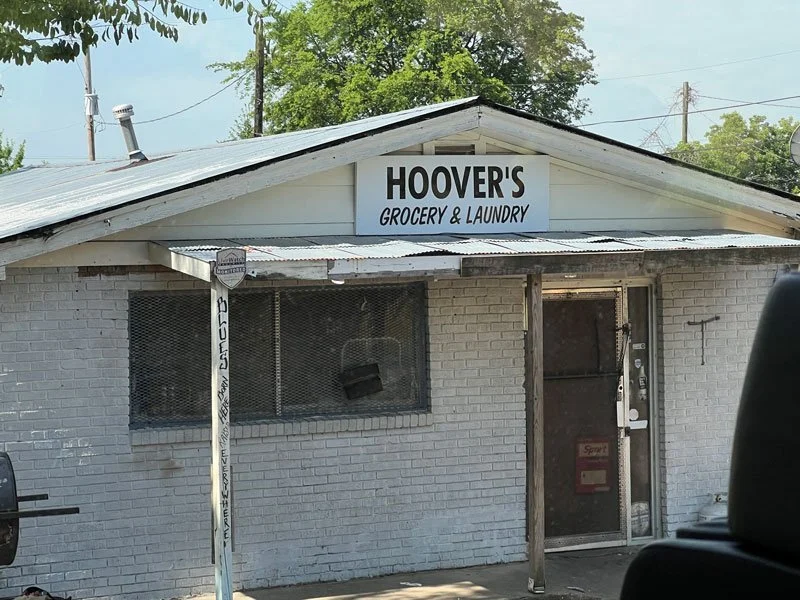
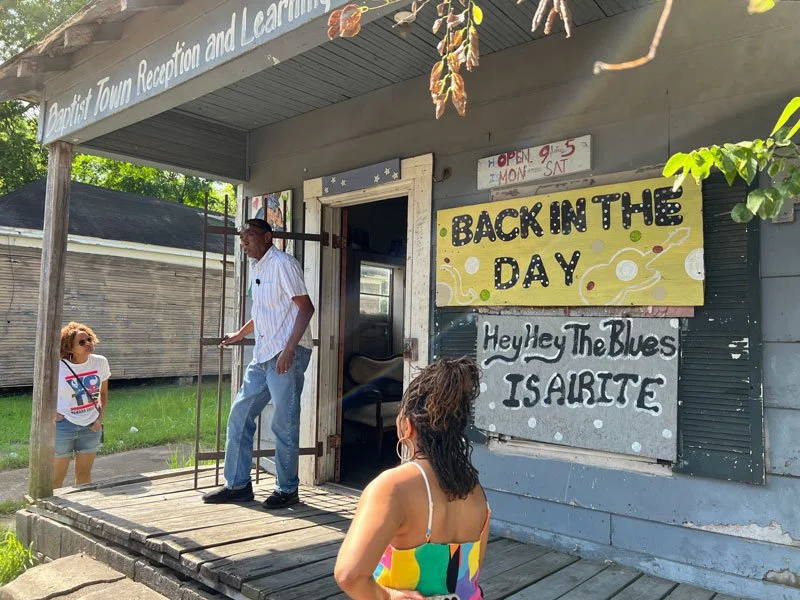
In conversation with our guide and through my own research, I learned more about Greenwood. It was home to many blues musicians and has many historical markers noting landmarks of musical and literary history. There are numerous schools in the area, but the public schools are 99% Black. The local population is 70% black. When segregated schools were outlawed in 1954, the whites abandoned the public schools and set up private schools for their children. That practice still exists today.
The Emmett Till statue went up in 2022. The city’s population had peaked in 1970 at a total of 22,400 and declined each year after that. I suspect that the city came to realize that civil rights tourism could help stabilize the local economy and population. The city is part of the Mississippi Delta National Heritage Area which was created by Congress in 2009. Local Civil Rights history brochures and maps are distributed to tourists, including our travel group. They identify historic sites too numerous to visit in one trip. Many of the historic markers we saw were erected in 2011.

Sylvester Hoover talking about the Emmett Till statue in Greenwood, MS.
In some ways Greenwood was my favorite city to visit: lots of history, friendly people, beautiful hotel, good food and music. However, it appears they have more work to do to improve the living and educational conditions of their Black residents and to create more museums and businesses that celebrate Black culture and civil rights history. No matter how much I enjoyed my visit, I couldn’t avoid thinking about troubling parts of its history and current status:
1. It was the second state to secede from the Union at the time of the civil war and Greenwood still maintains a 1913 confederate monument in the front of its courthouse. Officials voted to remove it but have made little progress in doing so.
2. According to the US News and World Report, the State of Mississippi ranks 48th as a desirable place to live, with a rank of 50 for healthcare, and a rank of 34 for PK-12 education. Many, if not most, schools remain segregated, since White students enroll in private schools.
3. Neighborhoods continue to be almost entirely White or Black and the contrast in the quality of the housing is dramatic.
4. The effects of slavery are still present today, as shown by the continuing struggle over voting rights and Black representation in government.
Mississippi Delta history is complicated. Visiting for a few days doesn’t provide a complete view of the area, so I apologize if I have misinterpreted what I have observed and researched. In my opinion, more investments, such as those made by the founder of the Viking Range Corporation, could help the area a lot. Renovation of more historic buildings would attract more visitors. Improved opportunities for Black residents to own and renovate homes and start businesses might also help. Greenwood is well worth a visit, and I hope it continues to improve with more business activity and tourism. Actual removal of the huge confederate monument in front of the courthouse would be a sign that the city is ready to move on from its history of slavery. Greater recognition of the history of native peoples who once lived in the area would also be an important step toward reconciliation with the area’s history.